
Squat: proper form and the mistakes the camera catches
The bodyweight squat trains your quads, glutes and core. Below: how to do a squat, the errors our pose engine flags on every rep, and the exact cue it gives you for each.
How to do a squat
- Stand with feet shoulder-width apart, toes turned out slightly.
- Brace your core, then sit your hips back and down.
- Go down until your hips reach knee height, knees tracking over your toes.
- Drive through your whole foot to stand up, squeezing your glutes at the top.
Engine thresholds · squat
How the camera judges your squat
The engine tracks 33 body points and follows each rep through five phases: idle, descend, bottom, ascend, lockout. A rep starts when the knee bends below 158°, and counts only when it reaches depth and locks out again.
Depth: knee angle
≤ 85°
Lockout: knee angle
≥ 168°
Errors checked
4
Try the rules
Move the sliders, see what the coach flags
A squat has three checks the camera makes on every rep. Change the numbers and watch each one turn from a tick to a warning at the same limits the app uses. The green stretch of each bar is the range that passes.
A model that explains the rules, not a recording of the camera. The limits are the ones in the app's squat check.
What the camera catches
Common squat mistakes
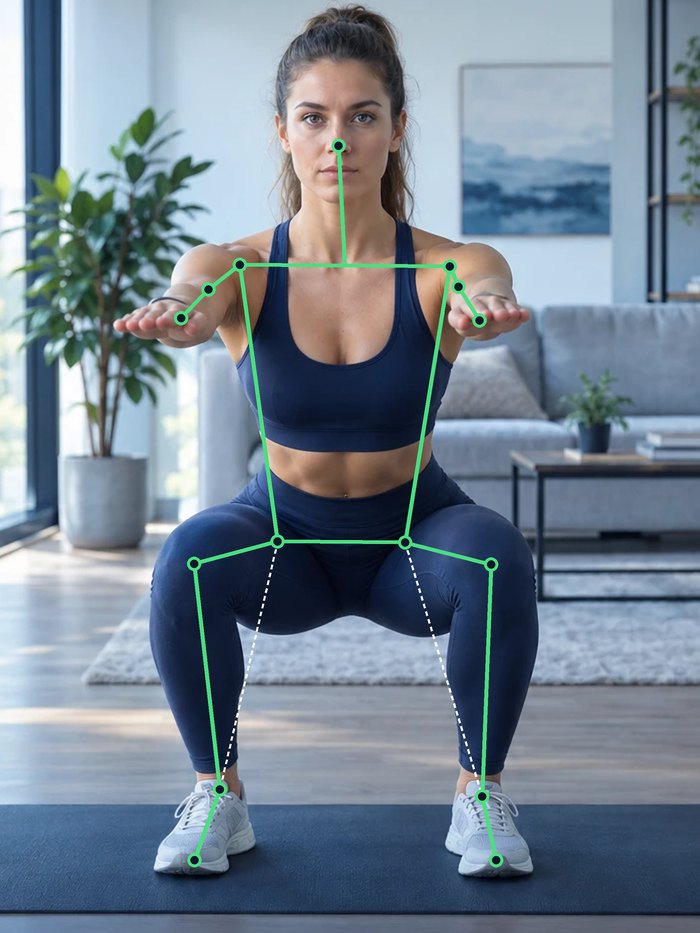
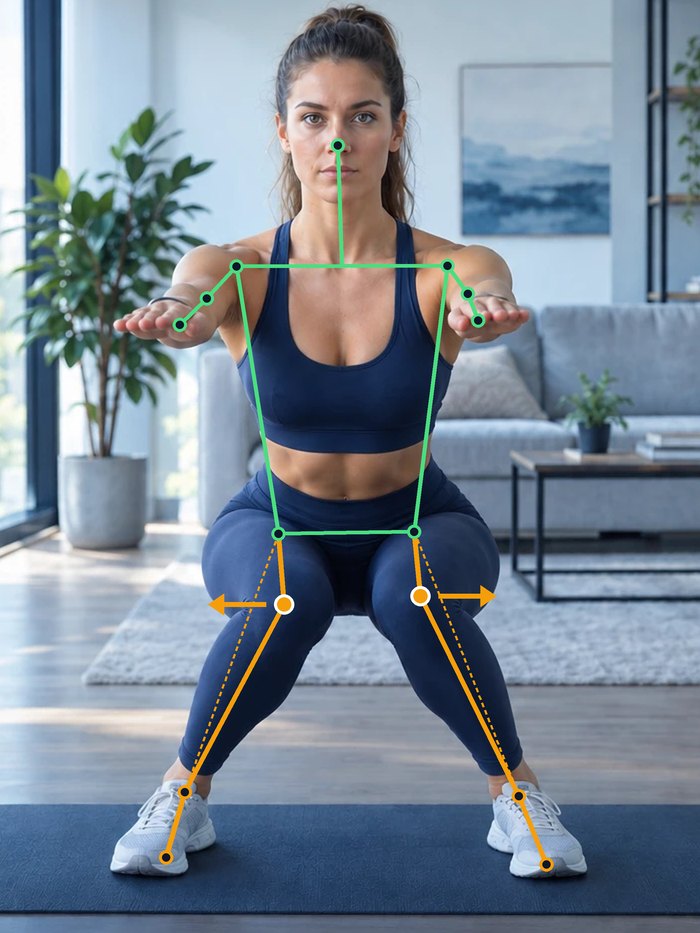
✕ Knees caving in✓ Knees over toesSkeletons are MediaPipe pose detections on these photos, not drawn by hand. The photos are generated; frames from a real session will replace them.
Knees caving in (valgus)
The knee drifts inward past the hip–ankle line at the bottom of the rep.
Trigger medial knee shift > 0.10
Fix: push your knees out over your toes as you stand up.
Rounded lower back
The torso angle collapses during the ascent.
Trigger back angle < 148°
Fix: brace before each rep and keep your chest up.
Not deep enough
The knee never bends past the depth threshold.
Trigger knee angle stays above 85° (±5°)
Fix: sit back until your hips reach knee height.
Unstable core
Your torso wobbles or the movement suddenly speeds up mid-rep.
Trigger back angle swings > 10° or speed jumps 2× your average
Fix: brace and keep your chest still as you move.
These are the thresholds the app uses for the squat (its own rule set plus the general checks in the pose engine), exported from the app's code for this page.
Squat questions
How deep should a squat be?
For most people, hips level with the knees. Go deeper only if your back stays neutral.
Should my knees go past my toes?
A little is normal. What matters is that they track in line with your toes, not inward.
How many squats should a beginner do?
Start with 3 sets of 8–12 with clean form; add reps once every rep scores well.